


You’ve got a skin issue that won’t quit. Maybe it’s stubborn breakouts that show up right before every big event, or a rash that flares up whenever the seasons change, or you just want that “glowy skin” look everyone keeps talking about on your feed. So now you’re stuck wondering: do I book a dermatologist, or is an esthetician the better call here?
Honestly, this confuses a lot of people, and it’s not your fault. Both professionals work on skin. Both have “skin expert” energy. Both can make you feel like you’re finally getting somewhere with your skincare routine. But the dermatologist vs esthetician question isn’t just semantics — the right choice can mean the difference between actually solving your problem and wasting months (and money) chasing the wrong solution.
In this guide, we’re breaking down exactly what separates these two professionals, when to see each one, what to expect from an appointment, and how to avoid the mistake so many people make of picking the wrong provider for their specific concern. By the end, you’ll know exactly who to call next time your skin acts up.
What’s the Real Difference Between a Dermatologist and an Esthetician?
Let’s start with the basics, because this is where most of the confusion begins.
A dermatologist is a medical doctor. That means they went through four years of undergrad, four years of medical school, a one-year internship, and then a three-year dermatology residency. After all that, many go on to complete fellowships in areas like Mohs surgery, pediatric dermatology, or cosmetic dermatology. They can diagnose diseases, prescribe medication, perform biopsies, and treat conditions that go beneath the surface of the skin — literally.
An esthetician, on the other hand, is a licensed skincare professional who focuses on the health and appearance of the skin’s outer layer. Their training typically involves anywhere from 300 to 1,500 hours (depending on the state) at a cosmetology or esthetics school, followed by a licensing exam. They’re trained in facials, extractions, chemical peels, waxing, microdermabrasion, and product recommendations.
Here’s the simplest way to think about it: a dermatologist treats skin as a medical organ, while an esthetician treats skin as part of a beauty and wellness routine. One is equipped to handle disease, surgery, and prescription-strength treatment. The other is equipped to help you maintain, refine, and enhance the skin you already have.
Neither one is “better” than the other — they’re just built for different jobs. And that’s really the crux of the dermatologist vs esthetician debate: it’s not about which professional is more qualified in general, it’s about which one is qualified for your specific concern.
When You Should See a Dermatologist
If your skin issue feels like it’s more than surface-level, this is your sign to book a dermatologist appointment.
Persistent or Severe Acne
Occasional breakouts? An esthetician can help you manage those with the right facials and product guidance. But if you’re dealing with cystic acne, painful nodules, or breakouts that keep leaving scars, you need a dermatologist. They can prescribe retinoids, oral antibiotics, hormonal treatments, or isotretinoin — options that simply aren’t available at a spa or skincare studio.
Unusual Moles or Skin Growths
This one’s non-negotiable. If you notice a mole that’s changed shape, color, or size, or a new growth that looks irregular, see a dermatologist right away. They’re trained to spot the early signs of skin cancer, and early detection genuinely saves lives. This isn’t something to bring up during a facial — it needs a proper skin exam.
Chronic Skin Conditions
Eczema, psoriasis, rosacea, and vitiligo all fall under medical dermatology. These conditions often have an inflammatory or autoimmune component, and they usually need prescription treatment to actually get under control. A dermatologist can also help you figure out your triggers, which — let’s be honest — can feel like solving a mystery on your own.
Sudden or Unexplained Skin Changes
Rashes that appear out of nowhere, hives, unexplained itching, or skin reactions to a new medication all warrant a medical opinion. Sometimes skin issues are actually a symptom of something happening internally, and only a doctor can connect those dots.
When an Esthetician Is the Right Choice
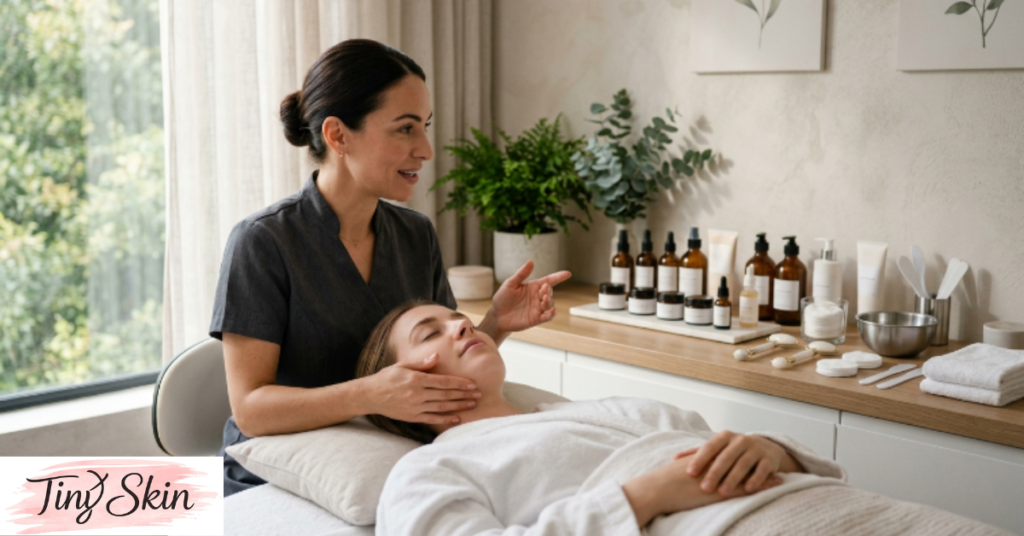
Now, let’s flip it. There are plenty of situations where an esthetician is exactly who you need — and honestly, going to a dermatologist for these would almost be overkill.
Regular Skin Maintenance
If your goal is simply healthier, more radiant-looking skin, an esthetician is your go-to. Facials, exfoliation, hydration treatments, and extractions all fall into their wheelhouse, and most people benefit from a monthly or bi-monthly visit.
Building a Skincare Routine
Not sure what order to apply your products in? Confused about whether you actually need a toner? An esthetician can walk you through building a routine suited to your skin type, and they’ll often recommend professional-grade products you won’t find at the drugstore.
Cosmetic Treatments Like Waxing or Peels
Light chemical peels, dermaplaning, microdermabrasion, and waxing services are standard esthetician offerings. These treatments improve texture and tone without addressing anything medical.
Pre-Event Skin Prep
Got a wedding, photoshoot, or big event coming up? This is a mistake a lot of people make — booking a random new treatment right before a major event without testing it first. A good esthetician will know how to time your facials so your skin looks its best on the day that matters, without any risk of irritation or breakouts.
Dermatologist vs Esthetician: Training and Qualifications Compared
Let’s get into the nitty-gritty, because understanding the training gap really clarifies why these two roles exist separately in the first place.
Dermatologist Education Path
- Bachelor’s degree (4 years)
- Medical school (4 years)
- Residency in dermatology (3 years)
- Optional fellowship (1–2 additional years)
- Board certification through the American Board of Dermatology
That’s roughly 11 to 13 years of education and training before a dermatologist sees patients independently. They’re licensed to practice medicine, which means they can order lab work, perform surgical procedures, and prescribe controlled medications.
Esthetician Education Path
- Esthetics program (varies by state, typically 300–1,500 hours)
- State licensing exam
- Optional advanced certifications (like medical esthetics or laser training)
An esthetician’s training is intensive in a different way — it’s hands-on, practical, and focused entirely on the skin’s surface. Many estheticians go on to specialize further, working in medical spas alongside dermatologists, which brings us to an interesting middle ground.
Can Estheticians Work Alongside Dermatologists?
Yes, and this happens more often than people realize. A lot of dermatology offices actually employ estheticians in-house. This setup is honestly pretty ideal, because it gives patients access to both worlds under one roof.
In this kind of practice, the dermatologist typically handles diagnosis, prescriptions, biopsies, and any medical procedures. The esthetician then supports ongoing skin maintenance — think facials, peels, or product guidance that complements the medical treatment plan. So if you’re being treated for acne with prescription medication, your in-house esthetician might also help you with gentle extractions or hydrating treatments that won’t interfere with your treatment.
Sound familiar? If you’ve ever visited a “medical spa” or “med spa,” this is exactly the model they follow. Just keep in mind: not every med spa has an actual dermatologist supervising treatments, so it’s worth asking directly before booking anything more advanced, like laser treatments or injectables.
Common Mistakes People Make Choosing Between a Dermatologist and Esthetician
Here’s the thing — a lot of the frustration people feel with their skincare journey comes down to choosing the wrong provider in the first place. Let’s go through the most common slip-ups.
Treating a Medical Condition With Cosmetic Services
Going to an esthetician for cystic acne or diagnosed rosacea might feel like a quicker, more affordable option, but it usually delays real progress. Estheticians aren’t licensed to prescribe medication, so if your condition needs a prescription-strength solution, you’re essentially putting a bandage on something that needs stitches.
Skipping the Derm for Mole Checks
In reality, a lot of people avoid dermatologist visits because they assume moles are a “someday” concern. Annual skin checks matter, especially if you have a family history of skin cancer or spend a lot of time outdoors.
Assuming All Estheticians Offer the Same Services
Esthetician licensing and scope of practice vary by state, and some are trained in more advanced procedures than others. If you’re looking for something specific — like a chemical peel with a higher acid concentration — always confirm they’re certified for it.
Not Communicating Your Full Skin History
Whether you’re seeing a dermatologist or an esthetician, walking in without mentioning your allergies, current medications, or recent treatments can lead to a reaction or an ineffective plan. Both professionals need the full picture to actually help you.
Dos and Don’ts When Choosing Between the Two
Do see a dermatologist first if you’re dealing with pain, bleeding, rapid changes, or anything that seems medically abnormal.
Do ask your esthetician if they collaborate with a dermatologist, especially if your skin concern is borderline.
Do bring a list of your current products and medications to either appointment.
Don’t rely on an esthetician to diagnose a medical skin condition — that’s simply outside their scope.
Don’t assume that “natural” or “gentle” cosmetic treatments are always safe if you have an underlying condition like eczema or rosacea. Check with a dermatologist first.
Don’t wait months to address something that’s getting progressively worse. Time matters more than people think when it comes to skin health.
Expert Tips for Getting the Most Out of Either Appointment
First things first — come prepared. Whether you’re headed to a dermatologist or an esthetician, a little prep goes a long way.
- Take photos over time. If your concern comes and goes, photos help the professional see patterns you might not notice day-to-day.
- Avoid new products right before your visit. Give your skin a break from actives like retinol or acids for a few days so it’s in its natural state.
- Ask questions. A good provider — dermatologist or esthetician — should explain their reasoning, not just hand you a prescription or a product list without context.
- Be honest about your budget. Both dermatology treatments and esthetic services range widely in cost. Providers can often suggest tiered options if you’re upfront about what you can spend.
- Don’t chase trends blindly. Just because a treatment is popular online doesn’t mean it’s right for your skin type or condition. This is genuinely one of the biggest mistakes people make, and it’s an easy one to avoid with a quick consultation first.
How to Decide: A Quick Self-Check
If you’re still on the fence, ask yourself these questions:
- Is this concern painful, spreading, or changing rapidly? → See a dermatologist.
- Do I just want better-looking, healthier skin overall? → See an esthetician.
- Have I already tried over-the-counter products without results? → A dermatologist can offer stronger options.
- Am I preparing for an event and want a glow-up? → An esthetician is your best bet.
- Could this be linked to a medication, allergy, or internal health issue? → Definitely a dermatologist.
When in doubt, start with a dermatologist. They can always refer you to an esthetician for maintenance once any medical concern is under control, but the reverse isn’t true — estheticians can’t diagnose or treat medical skin conditions.
Frequently Asked Questions
Is an esthetician the same as a dermatologist?
No. A dermatologist is a licensed medical doctor who can diagnose and treat skin diseases and prescribe medication. An esthetician is a licensed skincare specialist focused on cosmetic treatments like facials, peels, and maintenance routines.
Can an esthetician treat acne?
An esthetician can help manage mild acne through facials, extractions, and product recommendations. However, moderate to severe acne, especially cystic acne, typically requires a dermatologist’s prescription treatment for real, lasting results.
Should I see a dermatologist or esthetician for anti-aging concerns?
It depends on the severity. Fine lines and general skin texture can often be improved with esthetician-led treatments like peels or microdermabrasion. Deeper wrinkles, sun damage, or concerns about skin laxity are usually better addressed by a dermatologist, who can offer options like prescription retinoids or in-office procedures.
Do estheticians need a license?
Yes, in nearly every state, estheticians must complete a state-approved training program and pass a licensing exam before practicing.
Can a dermatologist do facials?
Some dermatology offices offer facials, usually performed by an in-house esthetician rather than the dermatologist themselves. The dermatologist typically focuses on diagnosis and medical treatment.
How often should I see a dermatologist versus an esthetician?
Most people benefit from an annual skin check with a dermatologist, more often if they have a personal or family history of skin cancer. Esthetician visits are more flexible and often scheduled monthly or every few weeks for ongoing maintenance.
Final Thoughts
At the end of the day, the dermatologist vs esthetician decision really comes down to matching the right expert to the right concern. If something feels medical — painful, changing, or simply not responding to over-the-counter care — a dermatologist is your best move. If you’re focused on maintenance, glow, and general skin health, an esthetician can absolutely get you there.
Your skin deserves the right kind of attention, not just any attention. So next time you’re staring in the mirror wondering who to call, come back to this guide, run through the self-check, and book with confidence. And remember — when a concern feels bigger than a bad breakout or a dull complexion, it’s always worth checking in with a board-certified dermatologist to be safe.

